


 Homepage
 Forum
Forum Drivers
 HMM-Manuals
 MTM
MTM Feed
Feed
The hard drive is a 2.5" SCSI, common with early Apple Powerbooks, and the CD-ROM is SCSI also. The 820 has quite a low RAM limit (48MB IIRC) but the 850/860 went up to 96MB or more. Overall it has a solid feel like the 750/755/760 series. The system setup is a lovely full-colour update of the classic 750 style system setup.


NT 3.51 PM (also known as PMZ or "power managed version Z") is an interesting beast - power management that was almost the equal of Win95 with suspend and hibernate. This was a special release of NT 3.51 that was ported at the IBM Kirkland Programming Centre in Seattle - I visited them in May 1997 when IBM sent me over to Seattle for an NT Cluster Server course at Microsoft. Kirkland had done the port of NT to PPC - I think that was the .01 version bump from 3.5 to 3.51 - and then they carried on to do the PM release of 3.51, then the PPC port of 4.0. Kirkland were also doing IBM's NT and Win95 hardware qualification - anyone supporting NT back then will remember the great long lists of hardware specifically tested and supported for NT 3.1 / 3.51 / 4.0. Lots of server, desktop, and portable x86 equipment in the lab area as you might imagine - including point-of-sale equipment and a few odd tablets that looked like greatly updated 730T models with hand straps and docking cradles. I never did work out what they were, perhaps prototypes or contract work for another manufacturer.
At the time I visited Kirkland they were very much in minimal maintenance mode with NT PPC, which was a shame as the guys there were so committed to the PPC hardware and proud of the work they'd done porting NT across. They had worked on the PM version of NT 4.0 PPC but it was canned before release. I had an interest in what they were doing as some months earlier I'd scrounged a PowerSeries 440 'Sandalfoot' desktop prototype back in the UK to run NT 4 PPC (so we could understand ARC bootloaders and software limitations/capabilities in the Helpcentre), and was looking to build support connections for escalating any specific NT PPC issues to them. I had also (then) just recently pulled a complete ThinkPad 850 setup off the crusher line at the dealer return centre in the UK. I gave the 850 to the Benelux agents at the Helpcentre and they were frothing at the prospect of an AIX laptop!
There's good summary info out there on the PPC ThinkPad hardware already - notably the same models of 820 and 850 were sold in parallel branded as either ThinkPad or RS/6000, with two parallel sets of type numbers for the same hardware depending on which part of IBM sold them (PC Company or RS/6000 division.) Mine is labelled as a 6040 on the box and both a 7247 and 6040 on the underside of the machine. They were manufactured in Japan, and the similarities with the 750/755 are obvious, inside and out.
Here's some more detail shots:
Full-colour splash screen during POST. Notice how it's a TFT screen with two sliders.

Audio controls on the front. Yes, the CD-ROM fit is gappy. Front latches are for lifting the keyboard.


Side latches open the screen.

Expansion port - I don't know of any external expansion options for these.

Rear ports: SCSI, floppy, parallel, serial, VGA, power, video break-out (under power). It uses a standard large power brick of the 700-750 era.

Memory is in 3x DIMM slots under the CD-ROM, max 16MB per slot. Same HDD cradle as the 75x series, but a SCSI drive inside.

Additional bits supplied. Classic rubber TrackPoint caps plus 'cat's tongue' variants. Video break-out dongle. Floppy bezel - but if the CD-ROM is SCSI, which floppy fits & works? Need to check.

The two type numbers. Note 'Manufactured by IBM Japan' rather than 'Made for IBM'; The architectural similarity to the 75x series is striking - was it a Yamato labs design?

Enjoy


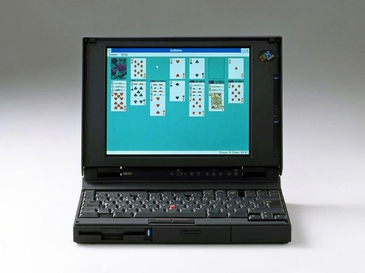


 Internally and externally it's an odd mix of familiar 750/755 general design & layout with unfamiliar additions, almost like an alternative development path to the 760 that was tried but then shelved. To reiterate a point that has come up before, these used a two-slider TFT, much in the vein of the 700C, 720C and early 750C. Either the Windows drivers are unfinished, or the panel supports a maximum of 65536 colours.


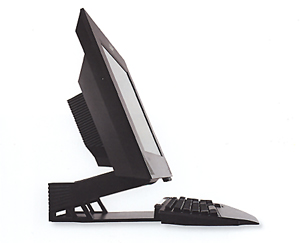
 510cs, 555bj, 860, Type 2435
